


In 2024, I “began my journey” with AI, by which I mean I started creating memes and editing funny photos of my friends and family with ChatGPT. From a business perspective, I saw few, if any, use cases for my daily routine, and I didn’t understand the point.
That changed when our external auditors asked me to draft some miscellaneous memos. I first used ChatGPT to create a goodwill impairment memo and analysis. I then used it to help with a going concern memo and a few other tasks I didn’t want to do. It was nuts. What would have taken hours took 30 minutes. Zero pushback, passed with flying colors.
Now, this seems trivial. And, candidly, it was. But this was my first glimpse of what these tools could do. No more memes and funny photos (just kidding, I would never). This was the start of a mindset shift toward what I could accomplish with them.
Same but different
In the 1800s, if you wanted to travel from New York to California, you’d do it in a horse-drawn carriage. You were responsible for managing the horse, navigating the terrain, checking for risks and threats, watching the road, and everything else. Exhausting but possible.
Now imagine making that same trip today in vehicle with full self-driving capabilities. The experience is completely different, but you’re still responsible for the outcome. You set the destination, oversee the journey, and verify the arrival.
That is how we should think about AI within an accounting function. Yes, the way you do things will change in the AI-native world. Yes, your day-to-day will be different. But you’re still responsible (as the human) for the output — the buck stops with you. This crucial to understand to become an Accounting Engineer.
Accountants are built for this
Accountants are some of the best adopters of AI. Here’s why:
1/ Accounting is a profession built on trust, accountability, governance, and reliance. That isn’t changing any time soon. By nature, accountants are taught to use professional skepticism and to “trust but verify”, always.
2/ Accountants understand assertions and their importance in financial reporting, control frameworks, and processes. As a result, the auditability of agents is top of mind. They understand how things should work and why. They don’t just accept things at face value — they pressure test processes from start to finish.
3/ Accountants love a good audit trail and documentation. They’re trained to find what is wrong before anyone asks.
The list goes on but I firmly believe that accountants who embrace the mindset shift in the profession will be the leaders of AI adoption at their companies.
What to hand off. What to keep.
There’s a lot of noise around this topic. Many opinions, guides, and “resources”. I’m not claiming to be a master here, but the way I look at it makes sense — at least to me.
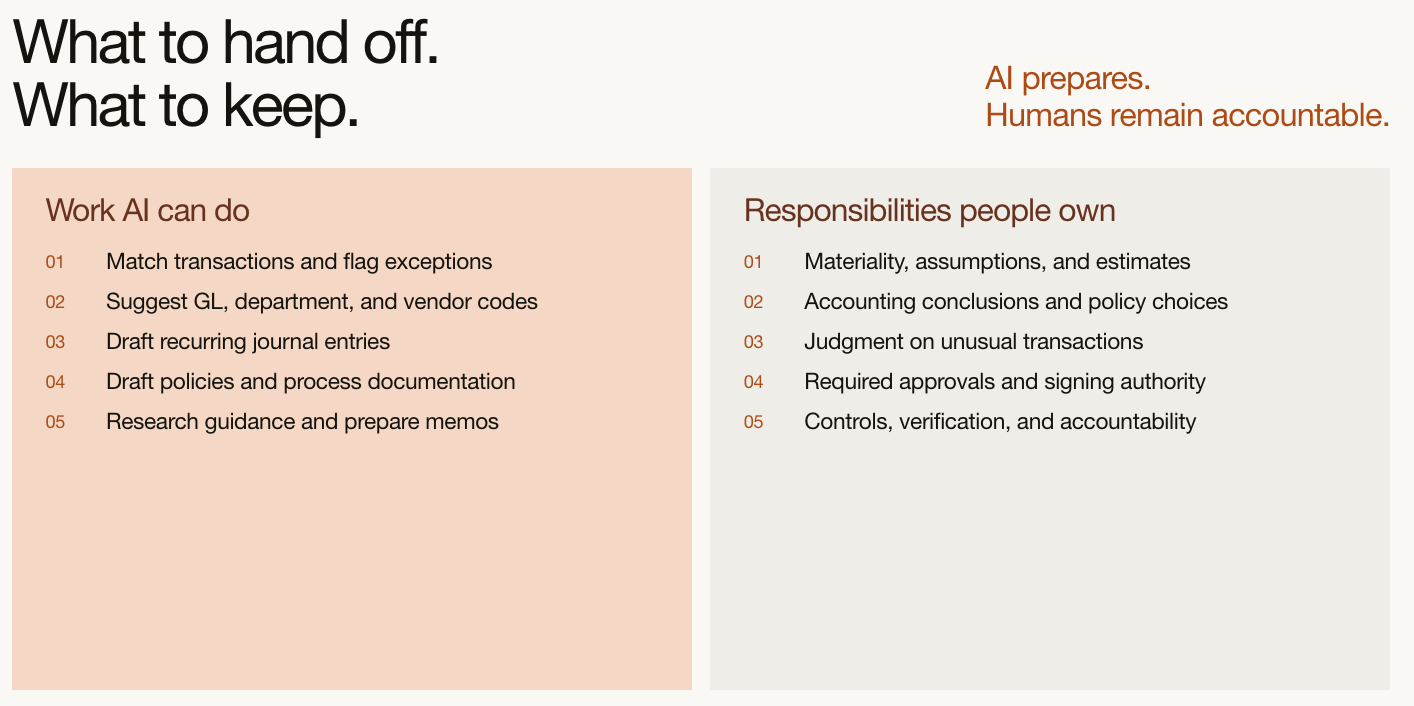
Rules-based vs judgment tasks. If a task is repeatable, low risk, and explainable, it can go to AI. If a task requires judgment, conclusions, or approval of any kind, it stays with the human. One caveat: in both cases, the final owner and approver should always be a human. It’s that simple.
Here are some examples of work AI can handle vs. work people should keep:
Where do I go from here?
Here’s some advice I wish someone had given me when I started using AI:
1/ Start small — look at the repetitive tasks you do today and pick the one you enjoy least. That’s where you start. It does not need to be material to have a material impact on your day-to-day.
2/ Avoid automation atrophy — I define this as attempting to automate too much with AI before you’ve properly built the foundation to support it. If you take on too much at once, you’ll run into analysis paralysis and hurt yourself in the long run. Instead, pick one task, pressure test it, confirm the output, and then move to the next automation.
3/ When you’re stuck, ask AI — this sounds crazy, but it works. Inevitably, you will hit hiccups along the way. When you do, ask your LLM what to do next. Use it as a thought partner to course correct.
4/ Break the mindset barrier — challenge the “same as last year” status quo and look for ways to improve the processes in front of you.
5/ Trust but verify — “the AI messed this up” will never be a valid response to your CFO, auditor, or board of directors. The buck stops with you, always. Don’t just accept outputs at face value. Pressure-test outputs, document the process, and retain the accountability.
You’ve got this.
Here’s my question to you:
I take a rule-based vs judgment approach. How do you decide when you will use AI and when to use a human? And why?
The purpose of New Age Accounting is simple: to empower accountants — at every level — to become builders, not bookkeepers. Whether you’re a staff accountant, a controller, or a CFO, there’s something here for you. Some topics will be high level, others will come with step-by-step guides, and some will include the exact prompts and tools you need to start building today.
If you’ve made it this far, you’re already thinking differently about this profession. Subscribe and come build with us.