


AI is still the buzz word that everyone in the profession is hearing but there has been a major shift. The fear of starting is diminishing. Accountants are taking the leap daily into AI, workflows and the new way of thinking. Time has been saved. Efficiencies are seen. Trust is being established. This momentum is real. Beginning is half the battle.
But, what’s next?
The fear of beginning is always there but once you start where should you now focus your efforts? I took a random survey amongst finance and accounting professionals. After ‘unsure of where to start’, the results were nearly unanimous — accountability and governance.
How do you establish tone at the top? How are you creating approvals and process controls? Who owns what? How can you maintain segregation of duties?
That’s the question.
The fundamental idea
Accountability and governance are crucial to the accounting profession. Without them, trust and reliance over the financial statements, and ultimate decision-making for a business, are nonexistent. They both serve an important purpose.
Governance is a framework of rules, internal controls, and processes. Accountability is the designation of responsibility. Simply stated: governance is the architecture and accountability is the enforcement mechanism.
It does not matter if you are a bookkeeper, audit partner, or work in the public sector. These two principles are at the foundation of accounting. Accountants are taught to be more than passive recorders and to be ethical stewards that challenge weak governance and provide strong safeguards over financial reporting.
Understanding each lens
Although simple from a definition perspective, it's important to understand how accountability and governance plays into both an auditor and operator perspective.
Auditor
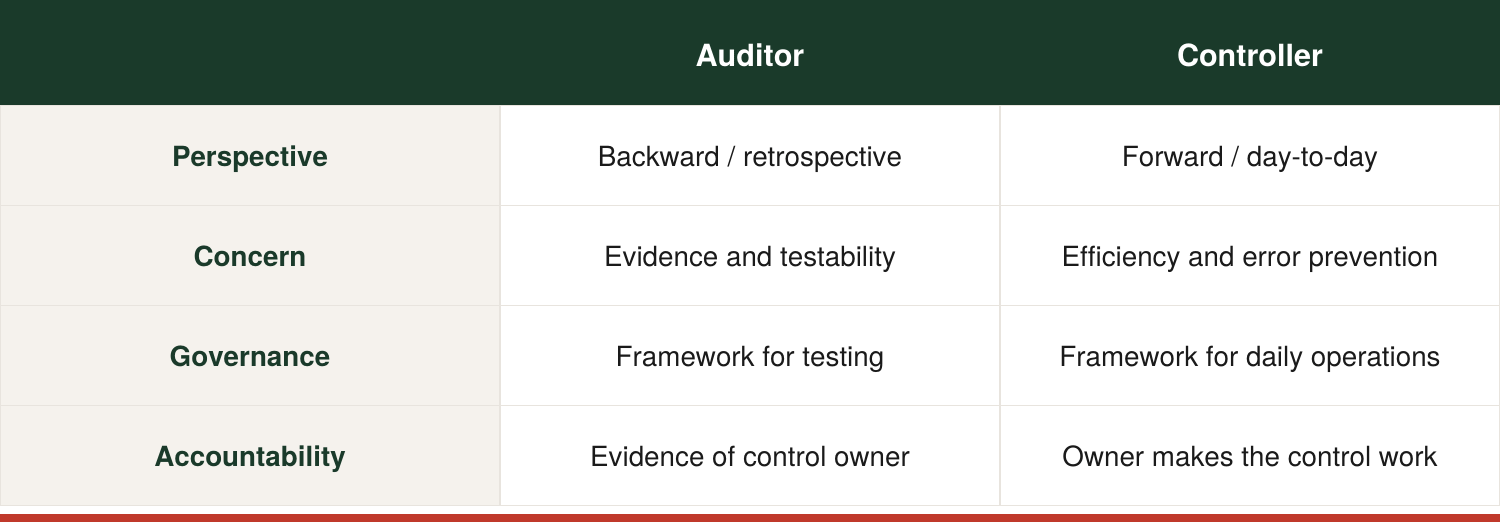
Governance — auditors want to understand that they can trust that an organization has a strong control environment that produces reliable financial information. They’re looking at segregation of duties, tone at the top, proper board oversight, policy documentation, traceability, and other control activities that will grant that assurance.
Accountability — auditors are searching for a proof mechanism. They perform procedures to test controls to ensure they are identifiable, have a responsible owner, and perform the intended procedures.
Operator
Governance — instead of being retrospective (auditor), governance is the daily building blocks that make the financial statements what they are. It is the approval workflows, close process checklist (controls), documentation habits, policy ownership, and systems/access controls that are in place.
Accountability — is less evidentiary (auditor) and is focused on the day to day operators for the team and entire organization. It is focused on defining the responsibilities of specific persons (preparer and reviewer), outcomes, sign-offs, and clear escalation procedures.
Here is a clear breakdown:
How does this change with AI
Short answer: it doesn’t (mostly).
Long answer: let’s break it down.
From a governance perspective, nothing changes. There should continue to be a framework of rules, internal controls, processes, etc. Auditors will continue to ask for evidence. Operators will still be required to build systems where that traceability exists before anyone asks about it.
AI doesn’t change the fundamentals of governance. It just changes the way we should be approaching them.
Example: proper segregation of duties should still be maintained. If a company connects their ERP to AI and uses AI to propose journal entries, a human should still be in the loop to properly review the proposed entry and subsequently approve that entry. AI should not be able to both propose and post their own entry.
If anything, I believe that the shift in AI has resurfaced something important — our ability to understand governance. Accountants fall into the SALY curse (same as last year) and at times lose their professional skepticism and ability to think outside of their system. Introducing AI has forced us all to rediscover the first principles of control activities that have become stale during the “system-generated” and “trust the ERP” era.
Accountability is where things slightly change. It’s always assumed a human decision maker who can explain the “why.” That is what has made accountability meaningful and not just procedural. However, if AI prepares anything and a human reviews the output, there is a risk that is real in form but hollow in substance.
Here’s what I mean: if a journal entry is prepared by AI and approved by a human, without proper judgement, the “control” existed but wasn’t properly performed.
Candidly, this isn’t a new problem. Auditors have always tested this — “does the reviewer actually review or just click approve?” The way it changes is in magnitude and frequency. AI has made it much easier to blindly approve and has made it much harder to detect because the output, on paper, is polished, well crafted, and confident — regardless of whether real judgement occurred.
The framework doesn’t change. Our mindset and awareness should.
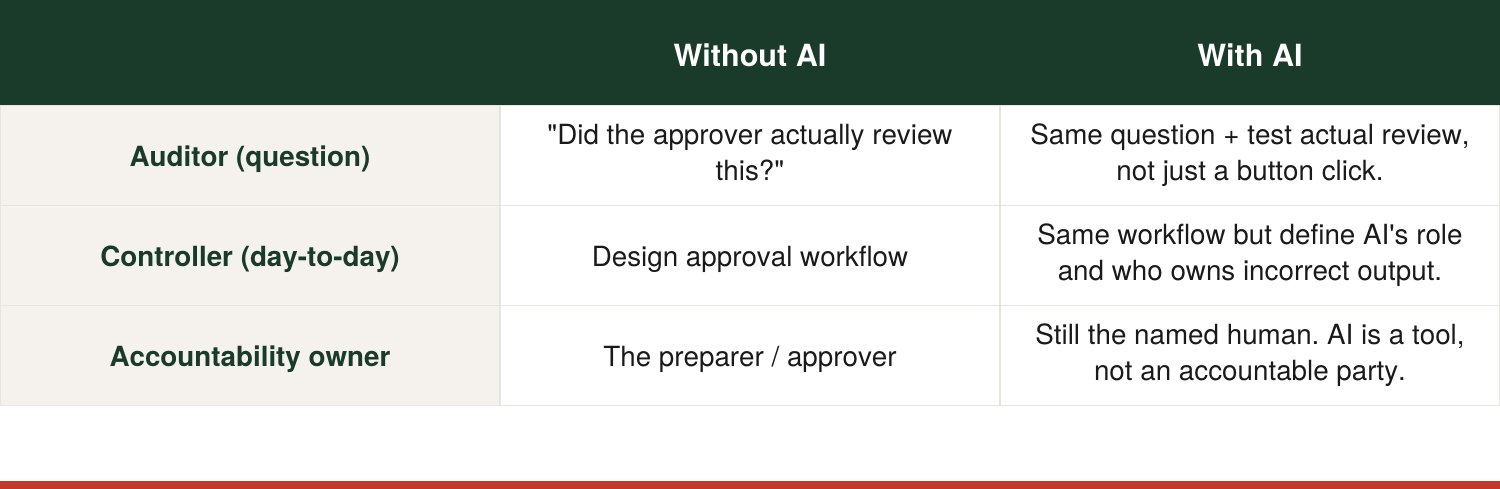
Governance doesn’t change but the awareness of it should. Accountability doesn’t change but mindful assignments should. AI is a tool and can never be the accountable party. There will never be a governance model where “AI approved this” is a valid answer to an auditor.
AI doesn’t lower the bar for human accountability. It raises it.
Here’s my question to you:
Where do you think the profession is most exposed right now — governance or accountability? And why?
The purpose of New Age Accounting is simple: to empower accountants — at every level — to become builders, not bookkeepers. Whether you’re a staff accountant, a controller, or a CFO, there’s something here for you. Some topics will be high level, others will come with step-by-step guides, and some will include the exact prompts and tools you need to start building today.
If you’ve made it this far, you’re already thinking differently about this profession. Subscribe and come build with us.